
General
CTC vs Orthodox Assam Tea: Which One Is Right for You?
Jun
If you’ve ever stood in front of two Assam teas — one made of tiny dark granules, the other of long twisted leaves — and wondered why they look nothing alike, this is the difference that matters most in Assam tea.
It isn’t the garden. It isn’t even the flush. It’s the method: CTC or orthodox. The same leaf, from the same garden, can become two completely different teas depending on how it’s processed. And knowing which is which is the single most useful thing you can learn before buying.
Here’s how to tell them apart — and which one belongs in your cup.
What CTC and orthodox actually mean
Both start the same way: fresh green leaf, plucked from the bush. What happens next sends them down two very different paths.
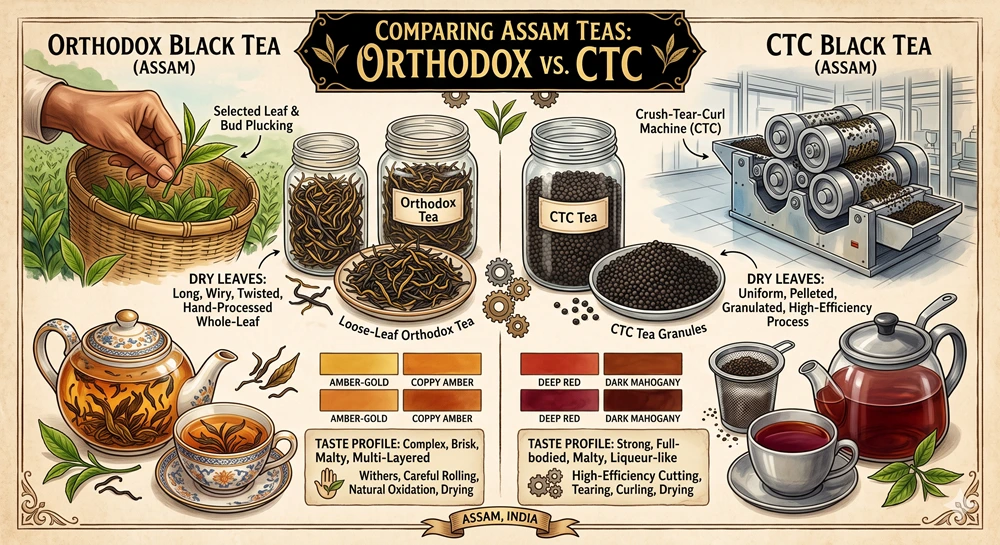
CTC stands for Crush, Tear, Curl. The withered leaf is run through rollers with sharp teeth that crush, tear and curl it into small, hard, uniform granules — like tiny dark pellets. This is the method behind most of Assam’s output, and it’s built for one thing above all: strength.
Orthodox is the older, slower way. The leaf is gently rolled to bruise it rather than shred it, so it keeps its shape — long, twisted, often with visible golden tips in a good lot. It’s then oxidised and dried with care. Orthodox processing is about preserving nuance, not maximising punch.
One word captures the whole difference: CTC is made for strength, orthodox is made for subtlety.
How they taste — and how they behave
This is where it becomes real, in the cup.
CTC brews fast, dark and bold. Because the leaf is broken open, it releases colour and strength quickly — a strong, brisk, full-bodied cup in two or three minutes. It stands up to milk and sugar without thinning out, which is exactly why it’s the heart of Indian chai and the classic Assam milk tea.
Orthodox brews slower and gives a more layered cup — smoother, rounder, with the malt, dried-fruit and honeyed notes a fine second flush is famous for. It’s complex enough to enjoy black, and good leaf can be steeped more than once, each infusion revealing a little more.
CTC vs orthodox at a glance
| CTC Assam | Orthodox Assam | |
|---|---|---|
| Looks like | Small, hard, dark granules | Long, twisted whole leaf, golden tips |
| Made for | Strength & briskness | Nuance & aroma |
| Brews | Fast, dark, bold (2–3 min) | Slower, layered, smooth (3–4 min) |
| Best with | Milk, sugar, masala chai | Black, or milk on the side |
| Caffeine kick | Quick and strong | Gentler, more gradual |
| Re-steep? | Not really | Yes, good leaf re-steeps |
| Ideal for | Everyday chai, milk tea | Sipping, savouring, gifting |
So which one should you buy?
You don’t have to choose a side. You have to match the tea to the moment.
Choose CTC if you take your tea with milk and sugar, make masala chai, want a strong morning cup, or need something brisk and reliable that brews fast. For the classic Assam cha most homes drink daily, CTC is the right tool. Our [Hookhmol Premium CTC] is built precisely for that cup.
Choose orthodox if you like to drink tea black, want to actually taste the garden, enjoy a smoother and more complex cup, or are buying a gift. June’s single-estate second flush is orthodox tea at its peak.
And honestly? The right answer for most tea lovers is both — a robust CTC for the daily chai, and a fine orthodox for the unhurried cup. They aren’t rivals. They’re different teas for different parts of your day.
A note on quality (it cuts both ways)
Here’s what trips people up: “orthodox” doesn’t automatically mean better, and “CTC” doesn’t mean worse.
A poorly made orthodox is a waste of long leaves. A beautifully made CTC from a good garden is a genuinely excellent cup. Method tells you the style; the garden and the care tell you the quality. That’s why provenance still matters whichever you choose — which we get into in our guide to buying authentic Assam tea in Guwahati.
The best way to settle it for your own palate is the simplest: taste them side by side. Brew a CTC and an orthodox from the same gardens we source — Halmari, Jogipathar, Mouling — and the difference will explain itself in a single sip.
You can do exactly that at our store on GS Road, Christian Basti, Guwahati, or order both online and run the comparison in your own kitchen. We are Assam — and we’re happy to pour you both.
Frequently asked questions
What is the difference between CTC and orthodox tea? CTC (Crush, Tear, Curl) tea is processed into small granules for a strong, fast-brewing, bold cup ideal for milk and chai. Orthodox tea is gently rolled to keep the leaf whole, producing a smoother, more complex cup best enjoyed black or with milk on the side.
Which is better, CTC or orthodox Assam tea? Neither is simply better — it depends on how you drink tea. CTC suits milk tea, masala chai and a strong morning cup; orthodox suits sipping black and tasting the character of a specific garden. Many tea lovers keep both.
Is CTC tea good for masala chai? Yes. CTC’s strength and briskness hold up to milk, sugar and spices without getting lost, which makes it the standard choice for masala chai and everyday Assam milk tea.
What does CTC stand for in tea? CTC stands for Crush, Tear, Curl — the processing method in which withered leaf is run through toothed rollers to form small, uniform granules that brew quickly and strongly.
Can you drink orthodox Assam tea with milk? You can, but a fine orthodox — especially a second flush — is usually best tasted black first to appreciate its malty, layered character, with milk added on the side if you prefer.
